
The Death of Taste in the Age of AI Content
Dec 11, 2025
AI-driven feeds and generative models push content toward sameness and erode personal taste. Be intentional: curate, journal, and use AI critically.

AI-generated content is reshaping how we perceive and express taste. While algorithms bring convenience, they often promote sameness, limiting originality and personal expression. This impacts not just art or writing but how you connect with what truly resonates. Over-reliance on AI can anchor your creativity to predictable outputs, making it harder to refine your preferences and maintain individuality.
Key Takeaways:
Algorithms Create Loops: Repeated exposure to similar content narrows your perspective.
AI Tends Toward Average: Generative AI outputs often lack originality, favoring safe, formulaic ideas.
Psychological Effects: AI suggestions can subtly influence your thinking, reducing your creative ownership.
How to Counteract This:
Be Intentional: Choose content actively rather than relying on algorithmic recommendations.
Practice Reflection: Regularly evaluate why certain content resonates with you.
Use AI Wisely: Treat AI as a tool for brainstorming, not a replacement for your judgment.
Journal Regularly: Capture your thoughts and preferences to preserve and refine your personal taste.
How AI Content Erodes Personal Taste
Algorithmic Feeds Create Uniform Aesthetics
Recommendation algorithms are designed to analyze your behavior and serve up content that aligns with your preferences [3]. While this might seem convenient, it creates a feedback loop where you're exposed to the same types of ideas and formats repeatedly. Instead of introducing you to a variety of perspectives, these algorithms reinforce a narrow, predictable aesthetic. This repetitive exposure lays the groundwork for generative AI's tendency to produce content that's safe and formulaic.
Generative AI Produces Average, Predictable Content
Generative AI models rely on massive datasets to predict what words or ideas are most likely to follow one another [4][7]. While this enables them to produce fluent and cohesive content, it also means they tend to favor conventional and unoriginal outputs. As Joy Desdevises, a researcher in AI creativity, puts it:
"Although generative AI demonstrates impressive fluency by producing a large number of creative ideas, its inability to critically assess their originality and overcome the fixation bias highlights the necessity of human involvement, particularly for properly evaluating and filtering the ideas generated." [4]
Research backs this up. Stories created with AI assistance were found to be 5.0% to 5.2% more similar to AI-generated ideas than those written entirely by humans [2][5]. This subtle influence shows how AI tools can nudge creative work toward sameness [6].
The Psychological Effects of AI Content
AI's impact goes beyond the content itself - it can also shape the way you think. The uniformity of AI-generated outputs doesn’t just define what you consume; it can limit your creative perspective. When you're introduced to AI-generated ideas early on, they can act as an anchor for your own creativity [6]. Oliver Hauser, Professor of Economics at the University of Exeter, explains:
"When people start with an AI suggestion, 'they get anchored to it,' leading to outputs that are more similar to each other." [6]
This anchoring effect can make it harder to develop personal tastes. Over time, you might struggle to differentiate between what truly resonates with you and what has been subtly shaped by algorithmic suggestions.
Why Personal Taste Matters for Growth
Taste Reflects Who You Are
In a world where AI often flattens creative expression into something generic, your personal taste becomes a reflection of your individuality. It’s shaped by your emotions, your memories, and the cultural influences that make you who you are. These deeply personal experiences not only define your preferences but also help you make choices that resonate with your true self - choices no algorithm could ever fully predict or replicate.
Your taste is what sets you apart. It’s the human touch that keeps your voice distinct in a sea of AI-generated sameness. By leaning into what feels authentic to you, you preserve the individuality that algorithms simply can’t mimic.
Creativity Drives Personal Growth
Expressing yourself creatively isn’t just about producing something new - it’s about challenging your mind to think in fresh ways. When you push past familiar patterns and experiment with ideas, you build mental resilience and adaptability. But here’s the catch: AI’s tendency to stick to safe, predictable outputs can stifle that growth.
An MIT study highlighted this issue, showing that people using ChatGPT experienced reduced brain activity in areas tied to creativity and working memory [[8]](https://www.newyorker.com/culture/infinite-scroll/ai-is-homogenizing-our-thoughts?amp;utm_medium=email&utm_source=RD Station). Even more striking, 80% of participants couldn’t recall details from their AI-generated work, with some feeling “no ownership whatsoever” over what they had written [[8]](https://www.newyorker.com/culture/infinite-scroll/ai-is-homogenizing-our-thoughts?amp;utm_medium=email&utm_source=RD Station). This lack of connection to their work drained their confidence and joy in the creative process. As Mike Peng, CEO of IDEO, aptly puts it:
"Creativity is all about not being mediocre and being on the edge" [1].
AI, by its very nature, often leans toward the middle ground - producing results that are safe and average. This can undermine the very essence of creativity, which thrives on boldness and originality.
Using AI Without Losing Yourself
AI can be a helpful tool, but only if you remain in control. The trick is to use it thoughtfully, ensuring that your personal taste and judgment guide the process. Your unique perspective - shaped by your feelings, context, and emotional connections - brings depth and authenticity that AI simply cannot replicate.
A study from Cornell highlighted how AI can unintentionally erode individuality. When Indian and American participants used AI for writing, their work started to converge, aligning more closely with Western norms. Professor Aditya Vashistha, who led the study, cautioned:
"Through such routine exposure, you lose your identity, you lose the authenticity. You lose confidence in your writing" [[8]](https://www.newyorker.com/culture/infinite-scroll/ai-is-homogenizing-our-thoughts?amp;utm_medium=email&utm_source=RD Station).
The takeaway isn’t to avoid AI altogether but to use it wisely. By staying intentional and keeping your critical judgment at the forefront, you can harness AI’s benefits while safeguarding the unique nuances of your creativity. It’s all about striking that balance - using technology as a tool, not a replacement for your voice.
AI exposes Who Actually Has Taste.
How to Rebuild Your Personal Taste
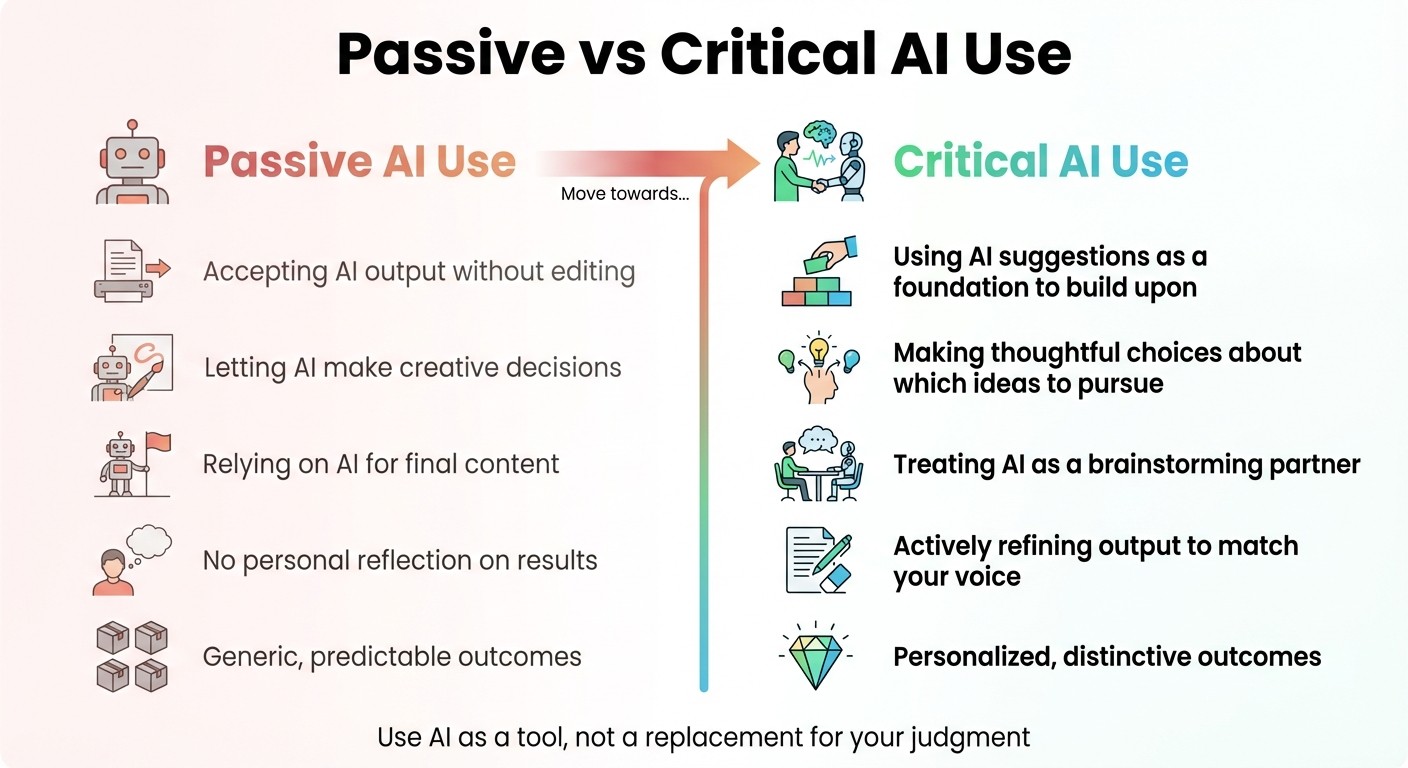
Passive vs Critical AI Use: How to Maintain Creative Control
After recognizing how AI can dilute individuality, it’s time to focus on reclaiming and refining your personal taste.
Review Your Digital Media Consumption
Start by examining your current habits. How much of what you consume is genuinely your choice, and how much is dictated by algorithms? Think about how you discover content - are you intentionally seeking out specific artists, writers, or creators, or are you simply scrolling through an endless stream of recommendations?
It’s worth noting the discomfort that arises when platforms seem to predict your preferences too well. To push back against this, try bookmarking creators who truly resonate with you. Engage directly with their work, and share your discoveries with friends. This small step can help you take control of your media diet [9].
Before content fades from your memory, ask yourself why it caught your attention. Reflect on questions like, “What about this resonates with me? What does this say about my preferences?” This kind of self-awareness can turn passive consumption into an intentional process of shaping and refining your unique taste.
Develop Your Taste Through Deliberate Practice
Rebuilding your sense of taste takes effort, especially in a world designed for quick, mindless consumption. One way to start is by time-boxing your exploration - dedicate specific periods to discovering new content and choose sources that challenge or broaden your perspective. For example, read long-form articles instead of skimming headlines, or listen to full albums instead of curated playlists.
The goal is to move from passive exposure to actively curating your aesthetic. When you encounter something new, give it the attention it deserves. Over time, this deliberate focus helps you make more conscious choices, sharpening your sense of style and self-expression [10]. These intentional decisions become the building blocks of your creative identity.
Use AI Tools Thoughtfully
AI can play a helpful role in supporting your personal taste - but only if you use it as a tool, not a replacement for your judgment. When AI generates content without your input, the results often feel generic. However, if you use AI for brainstorming, organizing ideas, or enhancing work you’ve already started, you remain in control of the creative process [25–28].
Think of AI as a starting point. Use it to spark ideas or draft initial concepts, but always refine the output to reflect your perspective. The table below highlights the difference between passive and critical use of AI:
Passive AI Use | Critical AI Use |
|---|---|
Accepting AI output without editing | Using AI suggestions as a foundation to build upon |
Letting AI make creative decisions | Making thoughtful choices about which ideas to pursue |
Relying on AI for final content | Treating AI as a brainstorming partner |
No personal reflection on results | Actively refining output to match your voice |
Generic, predictable outcomes | Personalized, distinctive outcomes |
AI-Assisted Journaling to Maintain Your Voice
Journaling offers a powerful way to reclaim your individuality in a world increasingly shaped by algorithms. By regularly writing about your thoughts, experiences, and personal preferences, you create a space that reflects who you are - free from the influence of generic AI patterns.
How Journaling Preserves Your Identity
When you journal consistently, you develop a deeper understanding of yourself. Writing forces you to articulate your emotions and opinions in your own words, making it easier to recognize what truly resonates with you. For instance, jotting down why a particular song moved you or why a design caught your eye helps you trust your instincts and sharpen your sense of self.
AI-assisted journaling can complement this process when used thoughtfully. The difference lies in control: you remain the source of insight, while AI acts as a tool to help you organize and explore your thoughts more effectively.
Next, let’s see how Pausa can fit into your journaling routine.
Using Pausa for Reflective Journaling
Pausa simplifies journaling by allowing you to record your thoughts in just 20 seconds - either through text or voice. The app then organizes these entries into daily summaries, making it easier to track patterns in your thinking and preferences over time.
With its weekly, monthly, and annual recaps, Pausa provides a broader perspective on how your tastes and interests evolve. This feature helps you differentiate between fleeting trends influenced by social media and deeper, genuine changes in your creative identity. Additionally, the goal-setting option allows you to focus on specific areas, like exploring a new art style or understanding why certain books resonate with you.
How to Structure Your Journaling Sessions
Start by capturing your immediate reaction to something - a song, a photo, an article, or even a conversation. Write down your raw, unfiltered thoughts before diving into analysis. Then, compare this with an AI-generated summary to see what stands out as uniquely yours.
Pay attention to where the AI misses the mark - whether it’s the emotional nuance, the subtle details, or the personal context that made the experience meaningful to you. These gaps highlight the aspects of your perspective that algorithms can’t replicate.
Before Journaling | After Journaling |
|---|---|
General sense of liking or disliking something | Clear understanding of personal preferences |
Swayed by popular opinions | Confident in your unique perspective |
Passive consumption habits | Thoughtful, intentional choices |
Algorithm-driven tastes | A distinct, personal aesthetic |
This approach works because true authenticity comes from aligning your words with your real beliefs and experiences. While AI can help you organize your thoughts, it’s your own reflection and self-awareness that bring depth and meaning to your journaling practice.
Conclusion
As we've explored the challenges of taste erosion and the importance of self-reflection, let’s focus on how to stay creatively distinct in a world increasingly shaped by AI.
AI’s impact on creativity hinges on how it’s used. Studies indicate that AI can enhance creativity by 10% to 11% for individuals who typically score lower on creative tasks [12]. However, it can also make outputs 5.0% to 5.2% more uniform [2]. Christian Terwiesch from Wharton’s Mack Institute puts it plainly:
"If you rely on ChatGPT as your only creative advisor, you'll soon run out of ideas, because they're too similar to each other" [11].
The solution isn’t to reject AI but to engage with it thoughtfully. Start with your own ideas and use AI as a tool, not the sole driver. Experiment with prompts, explore alternative suggestions, and shape the results with your personal insights, emotions, and experiences. This approach ensures AI serves as a springboard rather than a crutch.
Practices like journaling can help counteract the homogenizing effects of algorithms. By documenting what truly resonates with you, you can separate passing trends from your authentic preferences. This habit not only preserves your creative identity but also strengthens it, even as you incorporate AI into your workflow.
The creators who succeed in this AI-driven era share a common trait: they remain in control of their creative process. They use AI to enhance their work, not replace their judgment. By combining mindful media consumption with intentional self-reflection, you can leverage AI’s strengths while safeguarding your unique voice.
FAQs
How can I stay true to my unique style while using AI for content creation?
AI can serve as a helpful assistant, but using it wisely is key. Begin by utilizing it for tasks like brainstorming ideas, drafting outlines, or producing initial drafts. Once you have this foundation, invest the effort to refine the content by weaving in your own insights, personal tone, and creative flair.
To keep your work distinctively yours, highlight what sets your perspective apart. Infuse the content with your genuine voice, real-life experiences, and emotional nuances. Striking this balance ensures the final piece feels like your creation, with AI simply playing a supporting role.
How does consuming AI-generated content impact our mindset and creativity?
Regular interaction with AI-generated content can subtly shape the way we think and communicate. It often leans toward promoting uniform ideas, which might stifle originality and make it more challenging to hold onto a distinct point of view. Over time, this can create a disconnect from the creative process and reduce the emotional connection we feel toward the content we engage with.
On top of that, an overreliance on algorithm-driven content can limit self-awareness and personal development. By prioritizing ease and efficiency, it can discourage deeper, critical thinking. To push back against this, it’s important to approach content with intention and seek out activities that nurture individuality - like journaling or experimenting with creative tools that inspire self-expression.
How is AI changing the way we express creativity and personal taste?
AI has changed the way we approach creativity and personal expression by spotting patterns and creating content from massive datasets. Sure, it can speed up processes and spark ideas, but it misses something essential - emotional depth, intuition, and the lived human experience that fuel genuine originality.
Authentic creativity stems from our personal stories, emotions, and unique perspectives - things AI simply can’t reproduce. By being intentional about how we use AI tools and prioritizing activities that encourage self-expression, we can keep our individuality front and center in all our creative pursuits.