
Why “Engagement” Is the New Pollution
Dec 13, 2025
Platform-driven engagement is a form of digital pollution that erodes focus, fuels anxiety, and reshapes daily life.

Engagement on digital platforms is no longer just a measure of connection - it’s become a source of harm. Platforms are designed to keep you scrolling, clicking, and consuming content, often at the expense of your mental health. This constant push for attention can lead to anxiety, reduced focus, and even depression.
Here’s the problem in a nutshell:
Addictive design features like infinite scrolling, notifications, and variable rewards keep users hooked.
Algorithms personalize content to maximize screen time, often reinforcing negative emotional cycles.
Heavy social media use is linked to higher rates of mental health issues, especially among teens and young adults.
The rise in anxiety, poor sleep, and compulsive behaviors shows the hidden cost of digital overuse.
The solution? Recognize the warning signs of compulsive digital habits and take small, intentional steps to regain control. Tools like AI-assisted journaling apps (e.g., Pausa) can help you shift from mindless engagement to meaningful reflection, offering a way to organize thoughts and set goals without falling into the usual traps of endless scrolling.
Your attention is valuable - don’t let platforms dictate how you spend it. Start by setting limits, prioritizing offline moments, and choosing tech that supports your well-being.
How Digital Platforms Exploit Your Attention
Think of digital platforms as the gambling machines of the modern age. They're intentionally designed to hook you, using psychological tricks that tap into basic human instincts like the need for social approval or the fear of missing out (FOMO). This creates a cycle of habit-forming behavior, much like what happens with gambling or gaming [15, 16].
Why do they do this? Simple: more screen time equals more profit. Platforms earn money through ads and data, which means their goal is to keep you engaged for as long as possible. This creates a conflict where your well-being takes a backseat to their bottom line. The U.S. Department of Health and Human Services has even called for greater transparency and urged companies to put user health above revenue [3].
The impact is staggering. In 2019, nearly 970 million people worldwide were affected by mental health disorders, with anxiety and depression leading the charge [5]. In the U.S., the prevalence of major depressive episodes among adolescents jumped from 8.7% to 11.3% between 2005 and 2014 - a period that coincided with the meteoric rise of social media [3].
Governments are starting to push back. In January 2024, New York City officially labeled social networking sites as a public health threat. A month later, the city filed a lawsuit against TikTok, Meta, Snap, and YouTube, accusing them of fueling a youth mental health crisis [3].
So, what makes these platforms so addictive? Let’s take a closer look.
Addictive Design Features That Control Your Behavior
Some design features are practically engineered to keep you glued to your screen:
Infinite scrolling: By removing natural stopping points, platforms make it easy to lose track of time as you endlessly scroll through your feed [2].
Notifications: Those constant pings and alerts? They’re designed to trigger a small thrill, urging you to check for new likes, comments, or messages [2].
Variable rewards: Ever notice how you don’t always get the same level of engagement on your posts? That unpredictability - like a slot machine - releases dopamine, keeping you hooked on checking for likes or comments [17, 19, 21].
Algorithm-driven content: Feeds are personalized based on your behavior, showing you content tailored to your interests. While this might seem convenient, it strengthens your attachment to the platform and increases your screen time.
The Mental Health Cost of Constant Engagement
These addictive features come with a price. Many users develop compulsive habits, like obsessively checking their phones, struggling to limit usage, and prioritizing online interactions over real-life relationships [17, 18, 20, 21].
The cognitive effects are real. Constant digital stimulation shortens attention spans and makes it harder to focus on important tasks, leading to mental exhaustion [18, 21].
Young people, in particular, bear the brunt of these effects. Adolescents who spend more than three hours a day on social media are at a much higher risk for mental health issues compared to their peers who use it less [4]. Platforms that focus heavily on visual content have also been linked to body image issues and disordered eating, especially among teenage girls [4].
The problems don’t stop there. Screen time disrupts sleep, thanks to blue light exposure and constant alerts that delay sleep onset. Poor sleep then worsens mental health challenges, creating a cycle that’s tough to break [17, 18, 21].
Nearly one in five U.S. adults lives with a mental illness [3]. For those with severe mental health conditions, life expectancy is 10–20 years shorter than average [5]. While digital platforms aren’t the sole cause of today’s mental health crisis, their relentless focus on engagement has undoubtedly made the problem worse - and it’s an issue that can no longer be ignored.
Design Tactics That Drive Engagement Pollution
Tech companies have mastered the art of hooking users by designing features that tap directly into our brain's reward system. While these tactics may seem harmless, they create a digital environment that can be harmful to mental health, keeping users endlessly scrolling, clicking, and returning for more.
In 2024, researchers Chen, Fu, Chen, Radesky, and Hiniker analyzed 17 Very Large Online Platforms (VLOPs) and found 63 specific tactics, which they termed Extended-Use Designs (EUDs), spread across 583 instances. Social media platforms, in particular, employed twice as many of these tactics as other platforms. Examples include Infinite Scroll, Casino Pull-to-refresh, Neverending Autoplay, and Fake Social Notifications [7].
"EUDs do not always align with users' best interests. Hartford and Stein explain that digital platforms' aggressive - and often effective - efforts to co-opt users' attention reduce people's autonomy, displace alternative activities they value, and incrementally reshape their life experiences." [7]
These strategies fall into four main categories: offering enticing content, pressuring users with notifications or time-sensitive prompts, encouraging mindless scrolling, and trapping users within the platform. Together, these tactics create a relentless system designed to keep users engaged at all costs [7]. Two particularly effective methods - random rewards and algorithmic content shaping - play a significant role in this cycle.
Random Rewards and Social Approval Mechanisms
The Casino Pull-to-refresh feature operates much like a slot machine. Each swipe delivers an unpredictable result - sometimes a flood of notifications, other times silence. This unpredictability triggers dopamine surges, forming a feedback loop that encourages compulsive behavior [10].
Adding to this are mechanisms that exploit our need for social validation. Likes, comments, and shares deliver small bursts of approval that users quickly grow to crave. Data shows that over one-third of Gen Z users spend more than two hours daily on social media, and nearly half of both millennials and Gen Z check these platforms multiple times a day [11]. However, the curated nature of these platforms often leads to harmful comparisons. For instance, female Gen Z users report higher rates of negative body image (32% compared to 16% of males) and FOMO (32% versus 22% of males) [11].
How Algorithms Shape Your Digital Habits
Algorithms take these tactics even further by personalizing users' experiences. Every like, pause, or click is tracked to build a detailed behavioral profile. These systems monitor everything from your mood to your activity patterns and use this data to deliver "just-in-time" notifications and content tailored to keep you engaged [8].
This personalization can create a feedback loop where your mood dictates the content you consume, and that content, in turn, reinforces your emotional state. For example, if you engage with negative content while feeling down, the algorithm learns to show you more of the same, potentially deepening a negative emotional cycle [9]. Adolescents are particularly vulnerable, as their developing brains are more sensitive to rewards and less equipped to resist these traps. Over half of teens report being online "almost constantly", with around 40% wishing they spent less time on screens and social media [7][6].
How to Escape the Engagement Trap
Spotting the signs of harmful digital habits is the first step to regaining control and finding balance in your tech usage.
Warning Signs of Compulsive Digital Behavior
Awareness is key. If you’ve ever sat down to scroll for "just five minutes" and suddenly realized an hour has vanished, you’ve likely fallen into a common engagement trap. This kind of mindless scrolling often goes hand-in-hand with doomscrolling - endlessly consuming negative news or content, which can leave you feeling drained and anxious[1][12].
Another red flag? Feeling anxious or experiencing FOMO (fear of missing out) when you're away from your phone. Many describe an almost irresistible urge to stay connected, driven by a fear of being left out socially[1][12].
Your mental and physical health can also reveal a lot. Research links heavy social media use to higher rates of depression, anxiety, stress, and lower self-esteem[1]. On the physical side, issues like back and neck pain, eye strain, and poor sleep are common indicators of too much screen time[1]. Ironically, despite being constantly connected, you might feel lonelier and more isolated than ever[1]. If you notice a decline in your work or academic performance or find it tough to focus on everyday tasks, these are clear signs that digital overuse is interfering with your life[1].
Recognizing these patterns is the first step toward making meaningful changes.
Practical Steps for Mindful Tech Use
Once you’ve identified the warning signs, it’s time to take action. Start by setting clear screen time limits using tools already available on your devices. These limits help create a boundary between your online and offline worlds[1].
At night, power down your devices to signal a break from digital distractions[13]. Incorporate regular device-free moments into your routine - during meals, before bed, or on weekend mornings - to encourage real-world connections and recharge[1].
Be intentional about the content you consume. Focus only on material that adds value to your life[1]. Delete apps you don’t use, organize your inbox by unsubscribing from unnecessary newsletters, and clear out digital clutter[13][14]. If you frequently visit certain websites, bookmark them instead of keeping multiple tabs open or repeatedly searching for them[13].
These small but impactful changes can help you break free from harmful engagement loops and use technology in a way that feels purposeful and balanced.
Using AI-Assisted Journaling to Restore Focus
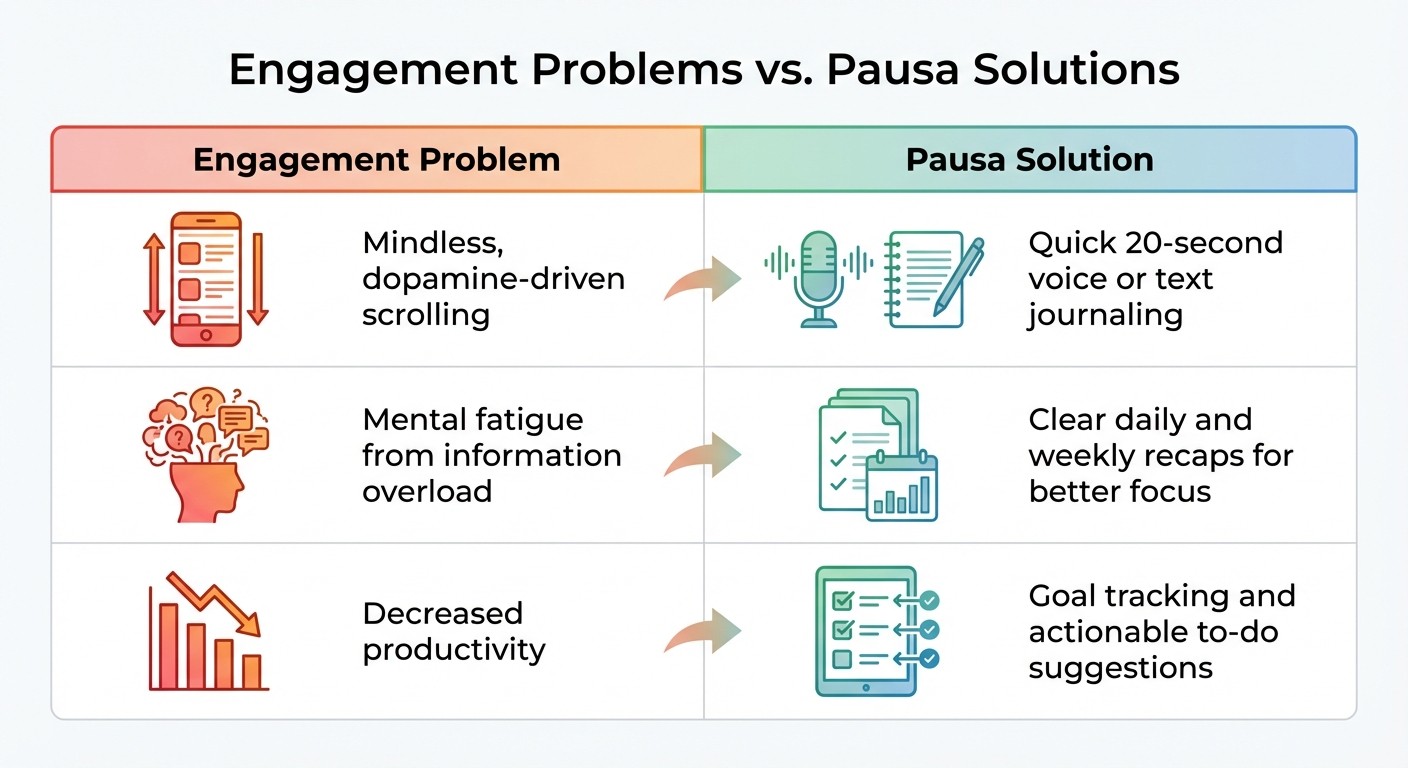
Engagement Problems vs Pausa Solutions Comparison
Now that we've touched on how digital platforms can pull our attention in every direction, let’s look at a tool that helps bring it back. Escaping the grip of endless notifications and mindless scrolling doesn’t mean you have to ditch technology entirely. Instead, it’s about choosing tools that enhance your mental clarity rather than drain it. AI-assisted journaling is one such solution, offering a quick and effective way to organize your thoughts without getting lost in the digital noise.
How Pausa Reduces Digital Overload
Pausa takes a fresh approach to digital tools. It allows you to record your thoughts in 20 seconds or less - whether by voice or text - and transforms these snippets into daily and weekly summaries. These summaries give you a clear picture of your progress and help you identify recurring patterns in your life.
The app’s suggested to-dos feature turns your reflections into actionable tasks, creating a natural connection between thinking and doing. Whether you prefer iOS, email, or WhatsApp, Pausa integrates seamlessly into platforms you already use. Unlike apps designed to keep you hooked, Pausa avoids the dopamine traps of engagement-driven platforms. Instead, it focuses on helping you reflect, set goals, and take meaningful action.
Engagement Problems vs. Pausa Solutions
Pausa’s features are designed to tackle the very issues that engagement-heavy platforms create. Here’s how it stacks up:
Engagement Problem | Pausa Solution |
|---|---|
Mindless, dopamine-driven scrolling | Quick 20-second voice or text journaling |
Mental fatigue from information overload | Clear daily and weekly recaps for better focus |
Decreased productivity | Goal tracking and actionable to-do suggestions |
While most digital platforms are built to keep you glued to the screen, Pausa is all about capturing what’s important and helping you move forward with clarity and purpose.
Conclusion: Taking Control of Your Digital Life
Engagement pollution isn’t just a tech issue - it’s a challenge to your mental health. The feelings of anxiety, depression, and exhaustion you experience after hours of scrolling aren’t random. They’re the result of digital platforms using addictive designs to keep you in an endless loop of stimulation.
Taking back control of your digital space doesn’t require drastic changes. It starts with small, deliberate steps. Notice when you instinctively grab your device without a real need, or when scrolling leaves you feeling mentally drained. These moments are signals that your mind needs a break from constant engagement.
Instead of avoiding technology altogether, try using tools that help you refocus. For example, AI-assisted journaling can turn distractions into opportunities for clarity. Apps like Pausa offer a refreshing alternative by creating a space to reflect and organize your thoughts. Unlike platforms designed to keep you endlessly scrolling, tools like these encourage mindful tech use and help you prioritize what truly matters.
Your attention is precious. Every moment spent lost in a digital haze takes away from meaningful work, personal connections, and growth. By choosing technology that supports your well-being, you’re not just protecting your focus - you’re taking back control of your life.
Don’t let algorithms dictate your time. Start with small changes, stay consistent, and rediscover the mental clarity you deserve.
FAQs
How do digital platforms’ addictive features affect mental health?
Digital platforms often include features specifically designed to keep users hooked, and while they succeed in boosting engagement, they can also have a serious impact on mental health. These addictive elements can lead to compulsive behavior, which, over time, contributes to issues like anxiety, depression, and emotional distress - especially among younger users.
Several factors play a role here. The constant drive to compare oneself to others on social media can create intense pressure, while late-night scrolling disrupts sleep patterns, leaving users exhausted and irritable. Additionally, spending more time online often comes at the expense of meaningful offline relationships, further affecting emotional well-being. Recognizing these habits is a crucial first step in breaking the cycle and reclaiming balance in daily life.
How can I cut back on screen time and build healthier digital habits?
Reducing screen time begins with creating clear boundaries for how and when you use your devices. For example, set specific times for tech-free moments, like during meals or before bedtime, and make an effort to stick to them. You can also take advantage of tools like app timers or screen time trackers to help you monitor and limit your usage.
Find joy in offline activities that allow you to unplug, such as reading a book, going for a run, or spending time outdoors. Simplify your digital environment by decluttering your devices to cut down on distractions, and turn off non-essential notifications to stay focused. Sharing your goals with friends or family can also provide the support and accountability you need to establish healthier habits.
How does Pausa’s AI journaling help reduce harmful digital engagement?
Pausa’s AI-powered journaling tool offers a refreshing way to break free from unhealthy digital habits. By encouraging thoughtful reflection and purposeful tech use, it creates a much-needed pause from the constant pull of screens, helping to restore mental clarity and balance.
Through promoting self-awareness and curbing compulsive digital behaviors, Pausa empowers you to build a healthier connection with technology. It’s designed to help you regain focus and put your well-being first in today’s tech-driven world.