
Watching Without Seeing: The Psychology of AI Slop
Dec 16, 2025
AI 'slop' is eroding attention and critical thinking—low-quality AI content fuels mindless scrolling; rebuild focus through journaling and intentional media habits.
AI slop refers to low-quality, AI-generated content that prioritizes speed and quantity over depth and substance. It’s designed to keep you scrolling, but it often lacks meaningful value. By 2026, up to 90% of online content could be AI-driven, leading to passive consumption habits that harm focus, critical thinking, and emotional resilience. Algorithms amplify this trend, creating echo chambers and promoting mindless scrolling.
Key takeaways:
What is AI slop? Simplistic, generative content focused on engagement, not quality.
Why it matters: Encourages cognitive laziness, dependency, and shallow understanding.
Impact on you: Distraction, reduced focus, and less self-awareness.
How to break free: Use reflective tools like journaling, set intentional media habits, and engage in offline activities.
Mindful habits, such as reflective journaling and intentional media consumption, can help you regain control over your digital life. Tools like Pausa simplify this process, turning passive habits into active reflection.
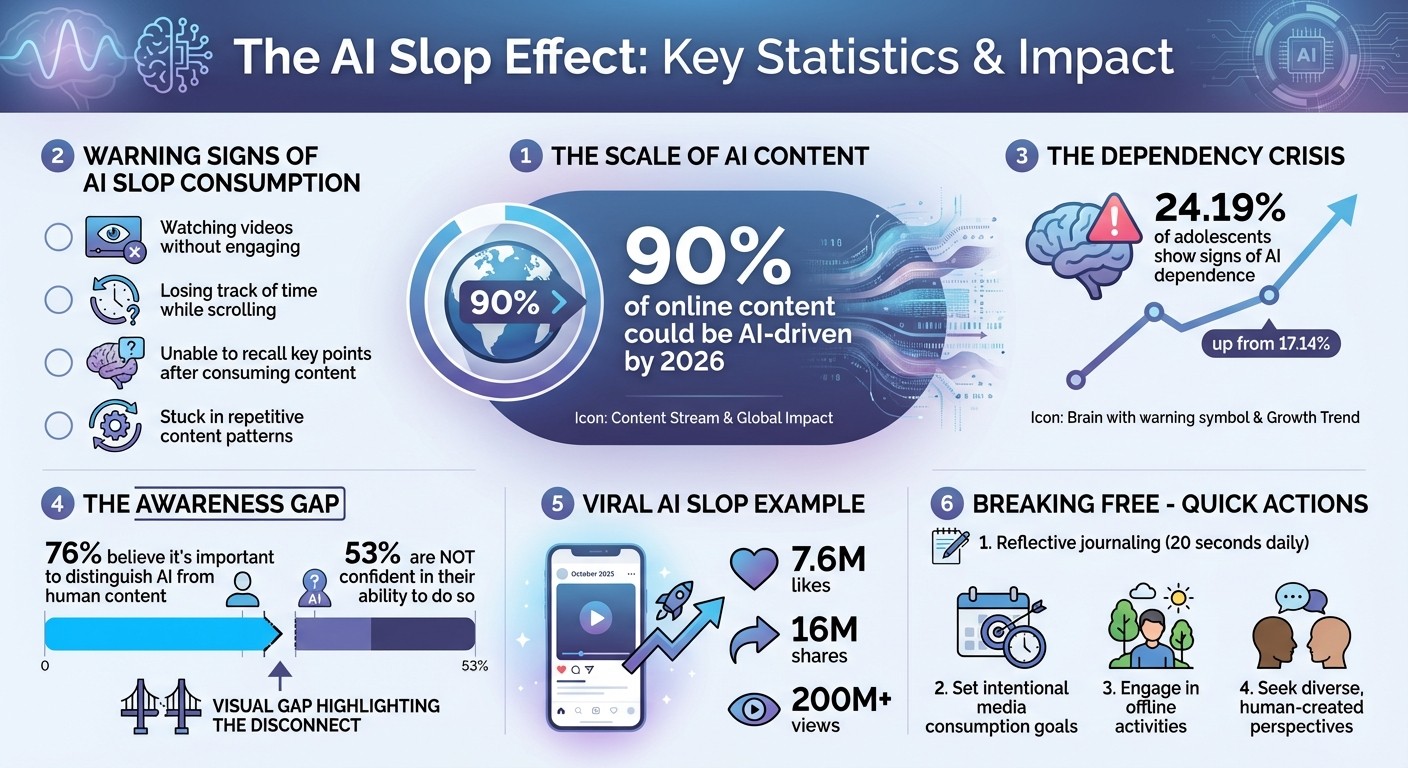
The Impact of AI Slop on Mental Health and Digital Consumption Statistics
How AI Slop Affects Your Mind
What Happens in Your Brain During Passive Consumption
Mindless scrolling puts your brain on autopilot. According to research from MIT, cognitive activity takes a hit as generative AI use increases [4]. This happens because you start handing over mental tasks - like remembering facts or reasoning - to AI. This phenomenon is called cognitive offloading [2][3]. Over time, this reliance builds what experts call "cognitive debt", leaving you with a surface-level understanding instead of deep, lasting knowledge [6].
These effects on your brain are similar to what happens with other digital addictions. Keith Robert Head, LMSW, explains:
"Neurocognitively, users who lean on chatbots for answers or emotional reassurance likely risk the same attentional lapses, working-memory deficits, and impaired risk appraisal linked to disrupted prefrontal and anterior-cingulate networks" [4].
This disruption rewires your brain’s reward system, making you crave instant, personalized responses. The result? A compulsive cycle that chips away at your ability to focus and remain self-aware.
The Impact on Self-Awareness and Focus
The damage doesn’t stop at distraction. Spending too much time with AI tools can lead to dependency, social withdrawal, and a decline in motivation for real-world activities [4][5]. Psychiatrist Marlynn Wei, M.D., J.D., highlights a deeper concern:
"Instead of promoting psychological flexibility, a sign of emotional health, AI may create echo chambers" [5].
These echo chambers can trap you in a loop of limited perspectives, further undermining your emotional resilience and focus.
How to Spot AI Slop in Your Daily Habits
Warning Signs of AI Slop Consumption
Your habits often reveal how much AI-generated content - or "AI slop" - you’re consuming. For instance, if you’re watching videos without engaging, you might be in a passive state [8]. This lack of interaction is a clear signal. Another clue? Losing track of time - you might find yourself scrolling endlessly or binge-watching an entire season, only to realize you barely remember any of it [8].
Think about how much you actually retain. If you finish a video or article and can’t recall a single key point, it’s a sign the content didn’t stick [7]. This happens because you’re not actively processing the information - it’s just passing by without leaving an impact.
Notice any repetitive patterns in what you consume? If you keep gravitating toward the same type of content without branching out, it’s a sign you’re stuck in a loop [8]. Instead of exploring new ideas or perspectives, you’re feeding a habit.
These behaviors aren’t random. They’re often the result of algorithms designed to keep you engaged, regardless of the content’s quality.
How Algorithms Keep You Hooked
Algorithms are all about engagement metrics - clicks, likes, views - not the quality or reliability of the content [1]. Your feed is filled with material crafted to grab your attention, not necessarily to inform or enrich. For example, in October 2025, a single AI-generated Instagram video garnered 7.6 million likes, 16 million shares, and over 200 million views. This demonstrates how effectively algorithms can amplify AI slop [10].
If your feed frequently stirs up anger or anxiety, it’s no accident. As Eryk Salvaggio from Cybernetic Forests explains:
"It is, I argue, a symptom of information exhaustion, and an increased human dependency on algorithmic filters to sort the world on our behalf" [9].
When you feel overwhelmed by the sheer volume of content - what experts call "information exhaustion" - it’s a sign that algorithms have already shaped your consumption habits [9]. You might stop questioning or investigating what you see, settling for content that feels "good enough" [9][10].
How to Break Free from AI Slop
Using Reflective Journaling to Regain Focus
The first step to breaking free is understanding your own thought patterns. Reflective journaling offers a way to process and evaluate your daily media consumption. By jotting down what you’ve watched, read, or interacted with - and more importantly, how it made you feel - you create a mental buffer between yourself and the content.
Relying too heavily on AI tools can dull critical thinking skills, as it shifts the burden of analysis away from you [3]. Journaling helps counteract this by encouraging you to actively engage with your thoughts instead of passively absorbing algorithm-driven content.
Start with simple, reflective questions: What did I consume today? Why did it matter to me? Did I actively choose this content, or was it chosen for me? These prompts build metacognitive awareness, helping you recognize when AI systems might be shaping your decisions [11]. This practice turns you from a passive consumer into someone who observes and evaluates their own media habits.
Pair these insights with intentional media choices to regain full control over your attention.
Practical Ways to Consume Media Mindfully
Reflective journaling is just one piece of the puzzle. To fully reclaim focus, you also need to make intentional media choices. Mindful consumption starts with deciding what you want before opening an app or browsing content. Set a clear purpose: “I want to learn about X” or “I need 15 minutes to unwind.” This shift transforms you from a passive observer into an active participant in your media experience.
Another key strategy is seeking out diverse, well-researched perspectives instead of relying on algorithmically curated content [11]. Look for materials created by human experts rather than summaries designed to maximize engagement.
Don’t underestimate the value of physical activities. Spend time in real-world sensory experiences - take a walk without your phone, cook a meal from scratch, or have an in-person conversation [11]. These moments of direct interaction with the world help maintain your mental and emotional balance. Researchers describe this as avoiding "embodied disconnect" [11]. Your brain thrives on tangible, physical experiences, not just digital ones.
Interestingly, surveys show that while 76% of Americans believe it’s important to distinguish between AI-generated and human-created content, 53% admit they’re not confident in their ability to do so [12]. By cultivating mindful habits and engaging more intentionally with media, you can sharpen your ability to discern and make conscious choices about what you consume.
How Pausa Helps You Build Better Digital Habits
Pausa's Features for Reflection and Clarity
Pausa offers practical tools to reshape your digital habits, making mindfulness an achievable part of your daily routine.
With Pausa, capturing your thoughts takes just 20 seconds - whether through text or voice. This quick, no-fuss method eliminates the need for long journaling sessions. And it’s not just convenient; it’s effective. Mindfulness, which is the practice of staying non-judgmentally aware of the present moment, has been linked to better emotional regulation, lower stress levels, and improved mental health [13].
What sets Pausa apart is how it transforms passive scrolling into active reflection. After you journal, the app uses AI to create daily, weekly, monthly, and even yearly summaries of your thoughts and behaviors. These recaps act as structured prompts, helping you spot patterns and better understand your emotional responses. Instead of endlessly scrolling through algorithm-driven content, you’re reviewing your own behaviors - what you engaged with, how it made you feel, and whether those choices aligned with your goals.
These features simplify self-reflection while offering clear insights into your digital habits. By automatically connecting your reflections to your broader intentions, Pausa helps you see whether your habits are pushing you forward or keeping you stuck in unproductive cycles. Research supports this approach, showing that mindfulness can ease the mental strain caused by technology and reduce stress associated with digital overload [14].
Building a Daily Journaling Habit with Pausa
Breaking away from mindless digital consumption takes practice, and Pausa makes it easy to start. Its flexibility lets you fit journaling into your existing routine - whether it’s jotting down thoughts in the iOS app with your morning coffee, sending a quick email reflection during lunch, or using WhatsApp while commuting. This adaptability ensures that reflection becomes a natural part of your day, not just another task to check off.
Regular journaling with Pausa helps you become more aware of your media consumption and its impact on your mental and emotional well-being [13][15]. Over time, this awareness becomes second nature. You’ll catch yourself zoning out during mindless scrolling and know how to redirect your attention before hours slip away.
Pairing Pausa with mindful media strategies amplifies its impact. Use the app to log what you consumed and why, then review your recaps to spot recurring patterns. Are your content choices intentional, or are algorithms steering the ship? Seeing your own reflections over time makes the answer clear. By weaving Pausa into your daily routine, you’ll regain control of your digital habits and make more intentional choices about how you spend your time online.
If You Want to Stop Scrolling, Try THIS
Conclusion: Taking Back Control of Your Digital Life
AI-driven content can subtly shape your habits by encouraging passive consumption. The first step to breaking free is recognizing this pattern. Recent studies highlight a concerning trend: 24.19% of adolescents now show signs of AI dependence, a jump from 17.14% in earlier years [17]. This shift underscores the urgency of addressing the issue.
Awareness is a powerful catalyst for change. Once you understand how algorithms are designed to keep you engaged [4][3], you can start taking steps to regain control. Establish boundaries around your use of AI-generated content and focus your energy on activities that bring real value to your life - whether that's pursuing hobbies, staying active, or nurturing meaningful relationships [18]. A simple yet effective habit is to pause and ask yourself: Am I benefiting from this, or just passing time?
"Recognizing and addressing GAID at this early stage is crucial to ensuring that AI remains a beneficial force in society." – Kooli Eya, Kooli Youssef, Kooli Chokri [16]
Tools like Pausa can help you turn self-awareness into actionable change. For instance, a quick 20-second journaling session can help you reflect on your daily habits, identify patterns, and align your digital choices with your personal goals. Instead of mindlessly scrolling, you’ll start consuming media with intention, transforming how you interact with digital content.
Taking back control doesn’t require a complete overhaul - just intentional, gradual changes. Start small by journaling your media habits and committing to one mindful choice each day. Over time, these deliberate actions will reshape your relationship with technology.
FAQs
How can I tell if the content I'm reading is AI-generated 'slop'?
To identify AI-generated content that lacks depth, watch for generic language, repetitive wording, awkward flow, or missing detailed examples. If the material feels overly smooth yet shallow, or it doesn’t provoke much thought, there’s a chance it’s AI-created. Trust your gut - if something feels off or overly simplistic, it’s worth scrutinizing further.
What are the long-term effects of depending on AI-generated content?
Relying too much on AI-generated content can chip away at critical thinking and self-awareness, making it tougher to engage with information in a meaningful way. Over time, this passive approach to consuming content might also strengthen confirmation bias - where we only seek out ideas that match our existing beliefs - and weaken cognitive flexibility, the ability to consider and adapt to new perspectives.
On top of that, mindlessly interacting with AI-driven content can lead to emotional fatigue and mental clutter. This can make it harder to focus, process information, or even think clearly. To counter these challenges, developing habits like mindful media consumption and setting aside time for self-reflection can encourage more deliberate and thoughtful digital engagement.
How can I build healthier habits for consuming digital content?
To build better digital habits, begin by evaluating how you use media - try keeping a journal or doing a self-check to understand your patterns. Establish clear limits on screen time and be deliberate about the type of content you engage with. Balance out screen use by incorporating activities that stimulate your senses, such as enjoying nature or diving into hobbies you love. These small but intentional changes can help you stay sharp and focused in today’s tech-driven world.