
AI Made It Easier to Create - and Harder to Care
Dec 10, 2025
AI makes creation faster and removes barriers, but can dilute your voice and sense of ownership—use AI for structure while keeping human judgment and reflection.
AI tools have made creating faster and simpler but have also reduced the emotional connection to the work. While they help overcome obstacles like writer’s block, physical challenges, or time constraints, this ease often leads to less personal involvement and satisfaction. The challenge lies in balancing AI’s efficiency with maintaining your voice and purpose.
Key takeaways:
AI simplifies creation: From drafting emails to writing articles, AI speeds up content production by automating tedious tasks.
What’s lost: Over-reliance on AI can lead to generic outputs, emotional detachment, and a lack of ownership.
How to stay involved: Use AI for structure or brainstorming, but ensure your ideas and insights guide the process.
Focus on quality, not quantity: Deep involvement in your work leads to more meaningful outcomes, even if you produce less.
The solution isn’t rejecting AI - it’s using it thoughtfully to support your goals without letting it overshadow your intent. Always prioritize reflection, personal input, and critical review to keep your work aligned with your values.
TEDxHKDI Humanity by Design: Creativity in the Age of AI | Josephine Wong & Daniel Szuc | TEDxHKDI
How AI Makes Creation Easier but Less Personal
AI Content Creation Statistics: Trust, Performance, and Consumer Perception
How AI Removes Creative Obstacles
AI tools are great at breaking down creative barriers, especially by automating parts of the writing process and easing the pressure of starting from scratch. Take, for example, a study conducted between November 2023 and July 2024. Creative writer P7, who struggles with carpal tunnel flare-ups, shared that using AI to draft initial versions allowed them to "actually write again." Similarly, writer P14, who faces physical challenges, found that AI leveled the playing field, enabling them to stay "competitive." Another participant, P12, who typically finds descriptive writing difficult, used AI to craft vivid imagery, saying it let them "indulge my childhood dream of being that type of person that can set a beautiful stage." In essence, AI acts as a creative safety net, helping writers keep moving forward when obstacles arise [2].
But while AI makes the process smoother, it can also introduce some unintended downsides.
What Gets Lost When Creation Becomes Too Easy
AI's ability to streamline the creative process often reduces the need for deep immersion or grappling with creative challenges [3]. However, relying heavily on AI tools to make decisions can result in emotional detachment and a loss of imaginative depth [4]. This ease can erode the personal connection that's so vital to meaningful creative work [5]. When the process becomes too effortless, the satisfaction of ownership and the sense of personal achievement can start to fade.
That’s why it’s so important to hold onto your unique voice in the midst of all this convenience.
Maintaining Your Personal Voice with AI Tools
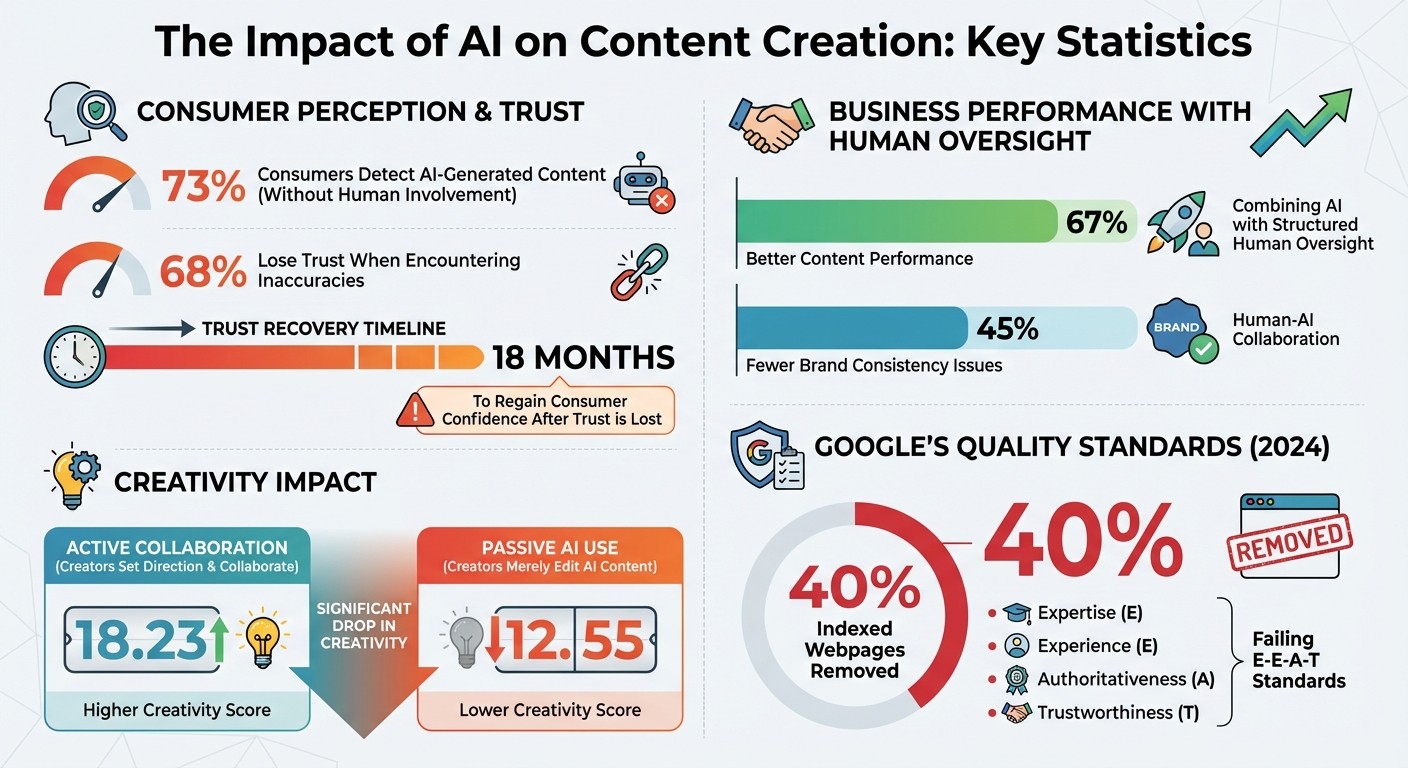
Even though AI can simplify creation, your individual voice is the key to keeping your work authentic. Without careful oversight, AI-generated content often defaults to generic, uninspired language - missing the distinct tone, style, and perspective that make your voice unique [7][8][9]. The numbers back this up: 73% of consumers can tell when content is AI-generated if there’s no human involvement, and 68% lose trust when they encounter inaccuracies. Worse, regaining that trust can take up to 18 months [10].
The solution isn’t to ditch AI but to use it as a tool to amplify your voice, not replace it [6]. Companies that combine AI with structured human oversight see 67% better content performance and experience 45% fewer issues with brand consistency [10]. In the end, it’s your personal touch - your insight, perspective, and authenticity - that makes your work stand out [6][9]. AI can help, but it’s your voice that truly resonates.
How to Keep Your Work Meaningful While Using AI
Adjusting AI Prompts to Match Your Goals
Start by clearly defining your role, objectives, and perspective to ensure AI supports your intentions rather than dictating them. Lay a human foundation for every project by creating a rough outline or jotting down your initial ideas in your own words. These early notes capture the raw emotion and originality that AI simply can't replicate. This approach ensures your work remains grounded in your unique voice and perspective.
Adding Personal Reflection to AI Workflows
AI can be a helpful tool for brainstorming and feedback, but the heart of your content should come from you. Open Web Engineer Schalk Neethling points out:
"AI is not a replacement for therapy or human connection, but it can serve as an accessible and immediate sounding board. It helped me clarify my thoughts, structure my emotions, and explore potential solutions without fear of judgment." [14]
Begin by writing the core sections yourself, then use AI to refine or enhance your work. This blend of human effort and AI input creates a more genuine result. To maintain your creative flow, pause periodically to add manual touches or rethink sections. When incorporating AI suggestions, critically evaluate them to ensure they align with your personal insights and intentions.
Reviewing AI Insights with a Critical Eye
AI-generated outputs should always be treated as drafts, not finished pieces. CX Expert Tori Signorelli advises:
"AI outputs for what they are - drafts that require human nuance and expertise to ensure accuracy, ethical use, and to reach their full potential." [15]
Carefully review summaries and patterns produced by AI, ensuring they reflect your goals and personal experiences. Paula Catoira, Chief Marketing Officer at Rival Group and Reach3, highlights the importance of this human oversight:
"AI can assist with first drafts, generate ideas, and collect information, but it's up to me and my team to ensure that the content aligns with our brand's voice and perspective." [16]
To refine your work further, consider printing drafts or reading them aloud. This process helps you identify inconsistencies, refine your tone, and maintain the authenticity of your voice [13].
Creating a Balanced AI-Creative Routine
To maintain your unique creative voice while benefiting from AI's capabilities, it's important to strike a balance. This routine combines AI's efficiency with your personal intent, ensuring the technology supports rather than overshadows your creativity.
Setting Clear Goals Before Using AI
Before turning to AI, define exactly what you want to achieve - whether it’s organizing ideas, polishing a draft, or exploring fresh perspectives. Be specific about the outcome you’re aiming for. This step ensures AI complements your creative process instead of taking it over [1][17].
For example, write down a simple goal like, "I want AI to help structure my weekly reflections, but the insights will come from me." This clarity keeps you in control and prevents the technology from steering your creative direction. When you know what you need, you’re less likely to let AI dominate the process.
Using AI for Structure, Not Ideas
Use AI to organize your thoughts - but let the ideas come from you. This method has been shown to enhance creativity while speeding up the process of refining concepts [18].
Start by brainstorming independently. Jot down your raw ideas, emotions, and observations in your own words. Once you’ve captured the essence of your thoughts, bring in AI to help arrange them into a coherent structure or to suggest areas for further exploration. This approach ensures your perspective remains at the forefront while leveraging AI’s ability to streamline organization. Studies have found that this type of human-AI collaboration encourages diverse and more creative outcomes [19].
Regularly Reviewing AI-Generated Insights
Set aside time to review AI-generated summaries to ensure they reflect your progress accurately. These check-ins are essential to confirm that the AI’s output aligns with your personal voice and growth [20].
If the summaries feel overly generic or fail to capture the emotional depth of your experiences, take the time to rewrite those sections. Your goal is to highlight what makes your perspective unique, not to let it be diluted into something impersonal [12]. Use these reviews as opportunities to fine-tune how you incorporate AI, ensuring it remains a tool that enhances your vision rather than replacing it.
This routine lays the groundwork for more meaningful and reflective creative practices moving forward.
Measuring Success: Depth Over Volume
With AI making content creation faster than ever, it’s worth pausing to ask: Does what you create truly matter? In 2024, Google removed 40% of indexed webpages because they didn’t meet its E-E-A-T standards - Expertise, Experience, Authoritativeness, and Trustworthiness[11]. This isn’t just a lesson for SEO; it’s a reminder for personal creative pursuits as well. Churning out more doesn’t necessarily equate to better. Real growth often stems from prioritizing quality over sheer volume.
Better Ways to Track Personal Progress
Instead of focusing on how much you create, consider how aligned your work is with your values and goals. Does it genuinely reflect your thoughts, or does it feel generic and disconnected?
Studies on poetry writing reveal an interesting insight: when creators set their own direction and collaborate with AI as a tool, creativity levels remain high. However, when they merely edit AI-generated content, creativity scores drop significantly - from 18.23 to 12.55[22]. This highlights the importance of staying actively involved in the creative process to maintain depth and originality.
Choosing Reflection Over Speed
Intentionality matters more than speed. As K.M. Weiland wisely puts it:
"To write with intention is to choose meaning over ease, depth over noise, and wholeness over quick results"[21].
This doesn’t mean rejecting AI entirely, but it does mean resisting the temptation to let it do all the heavy lifting. Taking time to think about what you truly want to express fosters a deeper connection to your work.
When you prioritize reflection, you’re not just creating content - you’re cultivating self-awareness and preserving your unique voice. Even if your output seems smaller, the value you gain from this intentional approach contributes to lasting personal growth.
Conclusion: Balancing AI Efficiency with Personal Meaning
AI isn't going anywhere, so the real question is how we choose to integrate it into our creative processes. The future of creativity thrives on human-plus-machine teamwork, not an either-or scenario[23]. Think of AI as a kind of "mind's exoskeleton" - a tool that enhances your thinking and supports your work - without replacing your unique judgment[24][15].
The real danger isn't using AI too much; it's using it passively. Simply accepting the first result it spits out without questioning or refining it robs your work of the qualities that make it meaningful[23]. Algorithms can't replicate your emotional insights, personal experiences, or the genuine connections you bring to the table[24][25].
To make the most of AI, let it take care of the repetitive tasks, freeing you up to focus on deeper, more creative work[24]. Use it to organize ideas, create frameworks, or spark inspiration, but always keep your own values and intentions front and center. Before you even start working with AI, take a moment to reflect: What do you want to create, and why does it matter to you?
Research shows that practicing mindfulness can reduce tech-related stress and improve your ability to stay present in the moment[26]. This sense of awareness helps you stay connected to your creative process, ensuring your work reflects your true self. It’s not about producing more - it’s about creating something that genuinely resonates with who you are and what you care about.
FAQs
How can I keep my unique voice when using AI for creative work?
To keep your voice distinct, think of AI as a helpful assistant rather than a substitute. Use it for tasks like drafting, organizing thoughts, or offering editing suggestions, but make sure the final polish and personal touches come directly from you.
Bring your own experiences, values, and perspective into your work. While AI can make the process smoother, your deliberate creative choices are what keep your content genuine and emotionally engaging.
What are the downsides of relying heavily on AI for creative work?
Overusing AI for creative tasks can sometimes strip away the personal touch that makes your work stand out. While these tools are undeniably helpful for boosting efficiency, they might unintentionally dilute your unique voice and the emotional depth that connects your audience to your creations.
Relying too heavily on AI can also hinder the growth of your own creative abilities. Over time, this dependence may make it harder to develop and refine your skills as a creator. The real challenge lies in finding the right balance - using AI as a helpful assistant while ensuring your personal vision and originality remain at the forefront of your work.
How can I use AI to enhance my creativity without losing the personal touch?
To get the most out of AI while staying connected to your work, think of it as a support tool for your creativity, not a substitute. Use AI to tackle repetitive tasks or spark fresh ideas, but make sure the final result carries your personal touch and perspective.
Blend human creativity with AI's efficiency by adding emotion, sincerity, and purpose to your work. Let AI simplify processes, but keep the critical decisions and creative direction firmly under your control to ensure your creations remain meaningful and relatable.